

Aside from Transformational NLP, one of the biggest influences of my transformational work is the Seth Material, authored by Jane Roberts, a channeler/medium for the Entity known as “Seth.” In Jane’s opening book, Seth Speaks: The Eternal Validity of the Soul, we are taken through a powerful journey of understanding how we have created the life and world we know. More importantly, it knocks on the door on something we all know deep on the inside but may have forgotten: our eternal validity.
In this post, I hope to discuss what validity is, why it matters, and one of the unfortunate consequences that come with forgetting our validity. Validity is not the easiest thing to define without using words that beget more requests for clarification. However, I will endeavour to do exactly so with words. Validity points to the inviolable integrity of one’s being, regardless of what you do or do not do.
If you can, in your mind’s eye, picture a 1 or 2 year-old baby. Any baby. Not necessarily you. With the wisdom of an adult, ask yourself which of the following attitudes feel more truthful and appropriate to take in relationship to that baby:
“This baby is inherently born with light and potential which can be supported to grow and flourish in uncountable ways.”
“This baby is inherently flawed and needs to be controlled. If they abide by certain ways of living they can prove their goodness and worth in this world, and perhaps, pay off the sin of existence.”
Generally, those who are right of mind and open of heart, would presuppose the first answer. However, I have found that people struggle to presuppose proper validity for themselves. More often, the latter seems to be the felt experience regardless of how much they would like to believe otherwise. My intention is to bring you closer to the felt experience of the first answer by remembering your validity, inherent goodness, and immeasurable worth implicit in your being.
Recall a movie or show that is cast around the protagonist having amnesia about who they are. Everyone might be saying, you're Rick, you're Rick, you're Rick. And he believes them because the evidence seems irrefutable. But until he remembers it himself, he doesn't know or feel that he is Rick.
Human Neurology and the Need to Belong
In a previous post, on the Anatomy of Fear, we covered a bit about human neurology, specifically, the four different brains we have. I have reinserted the illustration below for your convenience.
The ancestral portion of our brain, the reptile brain, is something we share with almost every creature on this planet. It only cares about safety, survival, and the 4F’s (fight, flight, freeze, fornicate). It does not consider quality of life as a success metric. It only considers that life continues regardless of its quality.
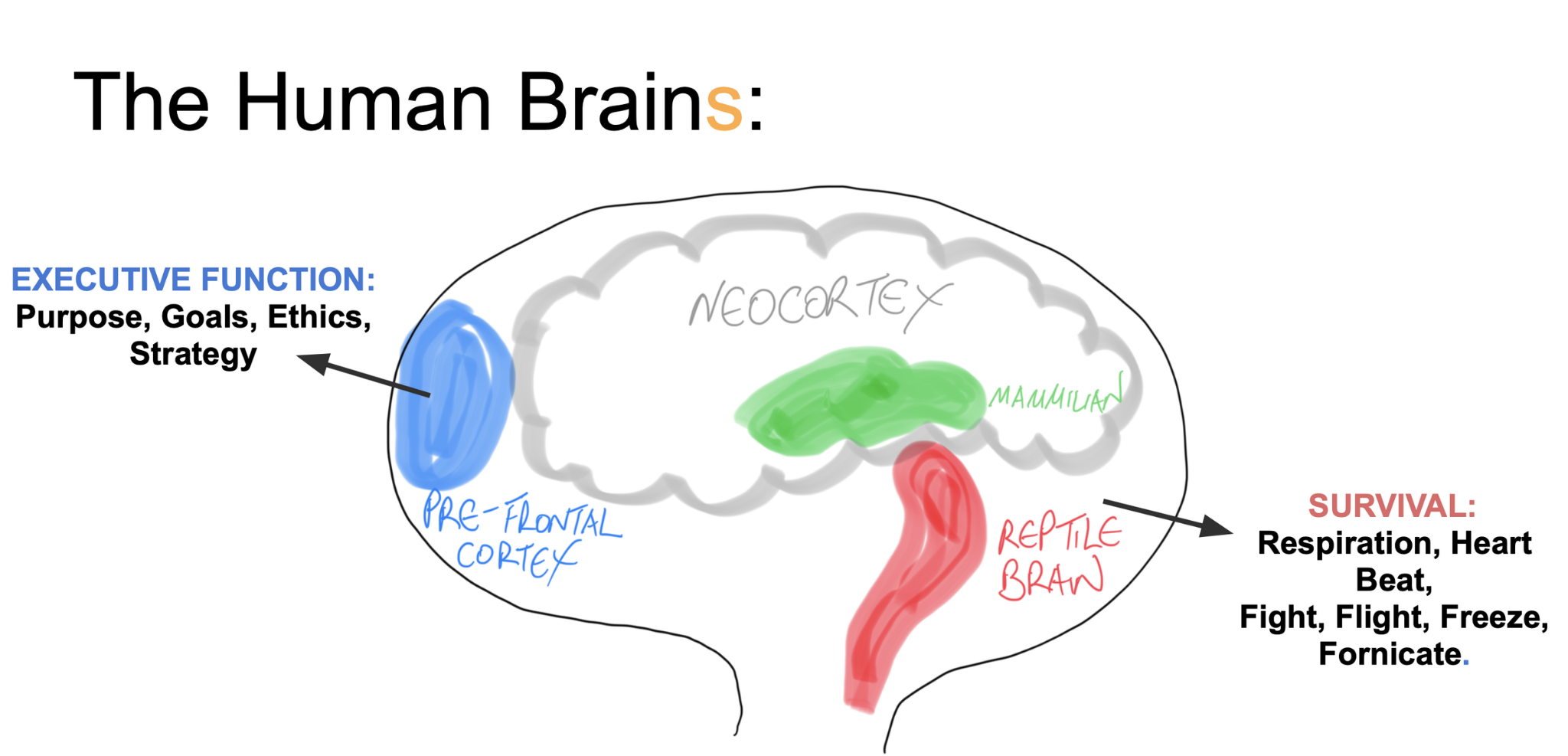
The Human Brains. Red is the reptile brain, green is the mammalian brain, grey is the neocortex, and blue is the prefrontal cortex.
When we incarnate into the human experience, we must look to our caregivers (no matter how negligent, ill-informed, or absent they are) for assistance to survive the early years of our creaturehood through bonding and mirroring our caregivers. During these early years, we are reptile brain dominant and early in developing our mammalian brain (emotional regulation). Therefore to focus is on safety and bonding; we learn through emotional experiences with our caregivers about what feels safe, what feels threatening, and what brings closeness (language of Love).
The pre-frontal cortex (the part that uniquely is in charge of sophisticated human qualities) is barely formed yet. For most adults, this pre-frontal cortex is not fully formed until late 20’s and 30’s! So, during these early years of your incarnation, there are a few important imperatives that must be met for human survival:
Basic food, shelter, and everything else your meat-suit can’t handle yet (e.g. crossing the road in busy traffic). Our caregivers, normally parents or a parent, must help do the things our neurology can’t handle yet (speech, emotional regulation, walking, feeding, sanitation). One of my main teachers, Carl Buchheit, used to say “Early parenthood is about performing the functions that the child does not have the neurology for yet.”
An education about how the world works and does not work. As such, children will almost always automatically mirror and adopt the core world view of their caregivers. This world view becomes foundational programming that the child builds upon as they mature physically, emotionally, and mentally over the years. No matter how limiting the rules or world view is, it is guaranteed to have survival value and some bonding value because of precedent. A child’s caregivers have survived (and the people they inherited from survived), therefore, there is a strong chance they can survive if they adhere to these rules!
Many of these rules are forms of misappropriated Love, which we covered in another post. Otherwise stated as rules of belonging, these automatically adopted rules have implicit ethical computations about what is right and what is wrong. These rules are used to determine our innocence (right) and our being guilty (wrong). Recall, in a previous post, Mechanics of Emotions, we covered how this forms the emotional boundaries for decision-making. And, the core belief that underlies this is: your validity (inherent goodness and value) is in question.
Because of the survival value of precedence, and, the time-delay for human beings to have all brains fully-functioning; we are by default living with this virtual question running our lives:
“How can I be good?”
We will then seek answers to this question because it gives us tremendous hope to be innocent. However, it gets more curious because of another implicit difficult core belief about self. Recall, we covered in the post about misappropriated Love, the underlying presupposition is that one can and will either hurt or harm someone without their consent. The underlying core belief is that one is powerless over their experience.
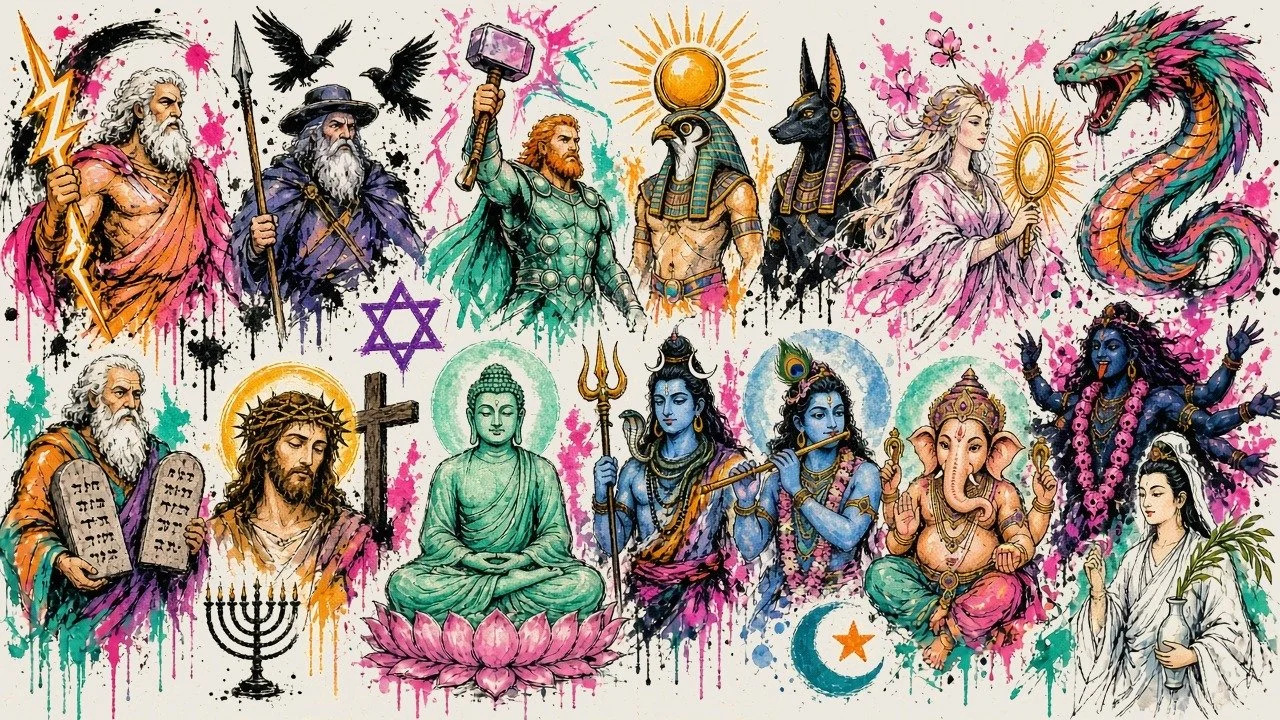
Imagine what we will create if we are chronically looking for answers to be “good” and also presupposing that “we are powerless”? Look no further than creating gods who are almighty and will set the ethical boundaries for our sense of self and life itself. As a species, our chronic addiction to external gods and authority figures is a manifestation of these unfortunate ancient special core beliefs. Little to any little one's knowledge, this inquiry leads to a dead end.
Addiction to Gods
Because the question “how can I be good?” inherently presupposed validity is in question, and because human beings presuppose that power is nested external to themselves, we will seek external world constructs to fulfil their sense of goodness for them. As such, our attention, energies, and powers are focused into some framework of living in the hope that we can seek resolution. That is to say, validity amnesia and the unique human development neurology, naturally forces us to misplace our personal power into external doctrines, programs, god figures, and authorities. These constructs will more than happily exist to govern the life we know and are a testament to our creating powers. We will synthesize these constructs together to create a unique mix that determines the boundaries for what is possible in our lives.
In Western civilization, these constructs form the main religions we know, like Christianity. Christianity is a wonderful creation in and of itself. And, very popular by design, since it does a few things generally speaking:
Matches your presupposition that your goodness is in question based on actions or inactions. Such as the metaphor of Adam and Eve, being a sinner, a flawed, fallen being etc.
Provides a path to salvation whether that is in repenting, confessions, lenten sacrifice, or accepting Jesus Christ into your heart to cleanse your sin. This matches the hope that comes with the question “How can I be good?”
Creates belonging (tribal safety and validation) that is absolutely glorious and full of its own benefits: partner potentials, career and business opportunities, monetary resources, networks, etc.
I do not believe Christian ethics are bad or good, but valid in their own right. Everything created has its validity and significance in the inexhaustible context of creation. But, this is to illustrate how powerful institutions can become manifest when the human mass consciousness maintains its validity amnesia, and displaces its personal power to externalities to determine the rules for their living. Of course, not everyone adheres to Christianity. There are plenty of other doctrines (Judaism, Islam, Buddhism), spiritual cults (look at the history of them in The Bay Area), business cults etc.
In government, humans place their hope that the right leader or system will finally be the savior, the one who improves our life. In systems of commerce, such as capitalism, we worship money. And the consumer. Because in capitalism, the consumer is an extension of the capitalistic god's hand. If you deliver value to that hand, and you can deliver at scale, that god rewards you. There's wellness and self-help gurus. The guru, the program, the perfect morning routine. If we follow the protocol, we are good. If we skip a day, we’ve failed as a human being. The list goes on, you can find solace in making “nature” your god while presupposing you are separate and fallen from it, you can become a militant vegan and assume you are a force of damage in the glorious cycle of animal life. The list goes on. Who and/or what are proxies for your personal power, I wonder?
The Addiction to Gods Is Valid, Yet Limiting.
Gods are not bad but they are part of living in a rewarding and punishing universe – rules for good (reward) and rules for bad (punishment). They are valid, and allow for an immense set of human experiences and learning.
However, if you sense that the rules of your doctrine or religion are limiting your experience in life, or conflicting with something else you want to explore, then perhaps it is time to revise the ancient beliefs you hold about your being and existence. I explore how beliefs shape experience in Working With Beliefs Part One and how to begin re-shaping them in Part Two.
The human race has projected their personal godhood onto an external figure so as to perceive and understand their power in a time-space construct. To understand the power that resides within you then, you have to look no further than that which you perceive holds great power in the world, or, that in the world which you perceive holds power over you. These are human creations.
But it begs the more important question: who are we as a species if we can create gods and the almighty institutions we know?
You are that which can create gods, but not limited to being a god itself. You are an eternal, inexhaustible light, sharing one of its beams in this time-space construct. That beam is the current incarnation you know.