

Picture this. Someone you love is about to walk through the door, and you have something to tell them. Maybe it's money you spent that wasn't in the plan. Maybe it's a job that fell through. Maybe it's the sentence "I need something different from us." You haven't said a word yet, and your heart rate has already gone up. Your palms are damp. Your eyes have dilated slightly.
Or maybe it's not a partner at all. It's the call you owe your mom, and you know she's going to ask why you haven't visited. It's the friend you have to say no to, again, and you've rewritten the text six times. It's the conversation with your manager about the leap you actually want to make. Different door. Same body.
In your mind, their reaction means they're a potential threat to your safety. Within your frame of mind, they could, at any moment, turn into a lion and eat you!
Question: how well can you think right now? Can you explain what happened, learn from it, or propose a way forward? Unlikely. You can probably feel it. You rehearse the same sentence four times, and it comes out worse every time.
The same thing happens at the bank statement you can't open. It happens before you ask for the raise, before you hit send on the application, and before you tell someone what you really want to do with your life.
So what's going on in there? To make sense of it, we need a quick tour of the brain. Not a biology lecture, I promise. Just the parts that matter here.
The Human Brains, Oldest to Newest
Human beings don't have just one brain. We have four: the reptile brain, the mammalian brain, the neocortex and the prefrontal cortex. A simple way to picture it: four layers, added one on top of the other over a very long time, like a house that kept getting extensions. (Biologists would add more detail, and that is fine.) This is the picture I find most useful when we're working with real people.
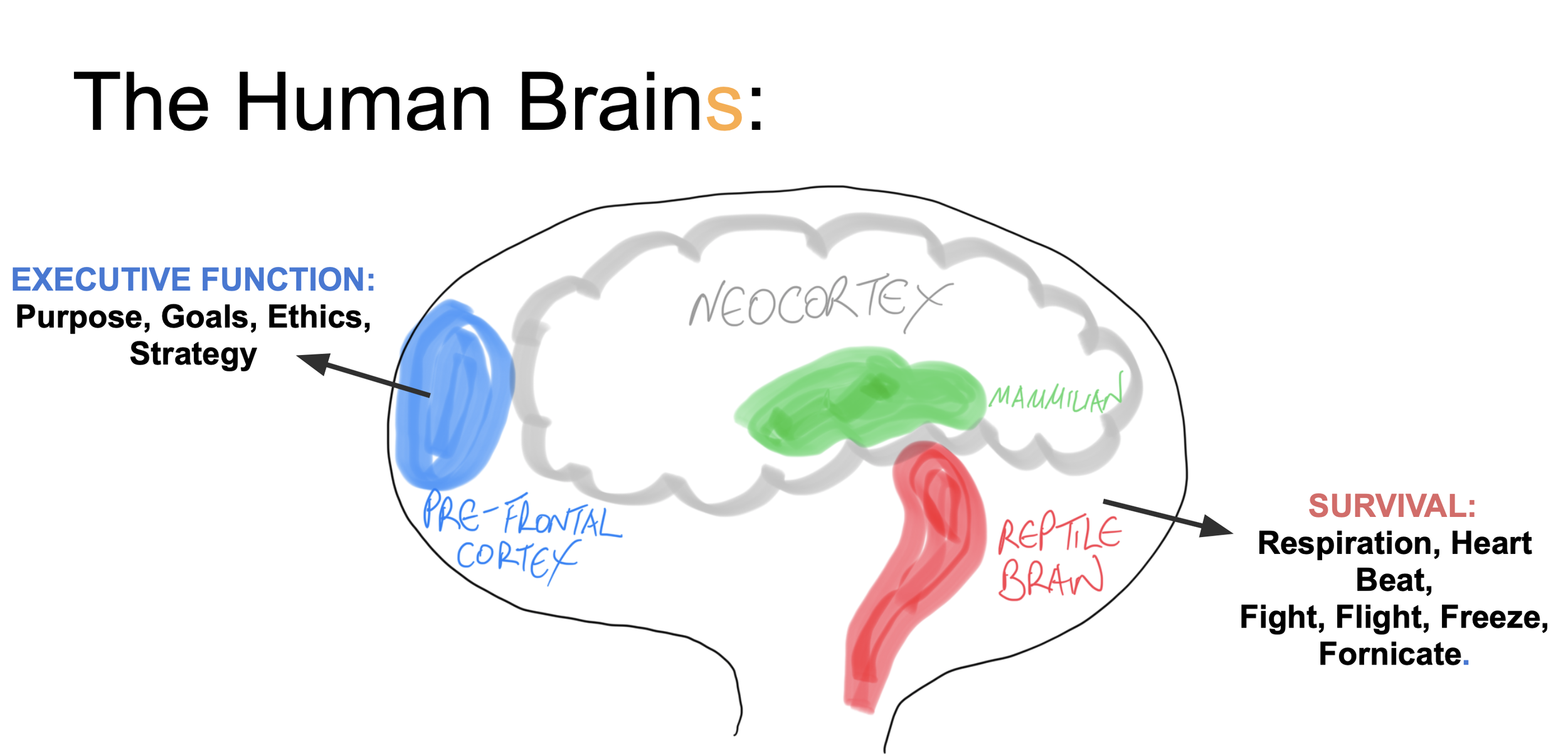
The Human Brains. Red is the reptile brain, green is the mammalian brain, grey is the neocortex, and blue is the prefrontal cortex.
1: The Reptile Brain (the red one)
The oldest is the reptile brain. We share it with all creatures on this planet. It controls vital functions like heart rate, breathing and body temperature, and its purpose is survival and continued survival. It's fast, it's automatic, and it doesn't ask your permission. You may have heard of the 4 F's:
Flight.
Fight.
Freeze.
Fornicate.
The main driver of the reptile brain is fear. And the reptile brain does not distinguish between what is real and what is imagined. Send it a series of sounds and pictures and it will take them as real. If you're watching Jaws in a theater, your heart rate suddenly goes up when the shark darts toward you from the screen. That doesn't seem logical. You're sitting in a theater, and there's no water around you. Your reptile brain can't make that distinction.
2: The Mammalian Brain (the green one)
Next up, sitting in the middle. This is the brain of emotion, bonding and belonging. It also holds our memory of what felt safe and what felt unsafe in our tribe: who was warm, who was not, what got you included and what got you pushed out.
This is where belonging matters. For most of human history, being cast out of the group wasn't an awkward weekend. It was a real danger. So this brain treats rejection like a threat to survival, which is why a friend going cold on you can feel oddly like a lion at the door. Hold onto this one. It comes back with our VP of Engineering.
3: The Neocortex (the grey one)
That's the big, wrinkled outer part, the one that looks like a walnut. It gives us language, perception, reasoning and imagination. It's the part reading this sentence, naming the feeling, and building the plan.
It's also the part that can imagine tomorrow's difficult conversation in full color, with sound effects. Remember the reptile brain can't tell real from imagined? Put those two together and you've got a very good recipe for a sleepless night.
4: The Prefrontal Cortex (the blue one)
The newest of the four. The prefrontal cortex is a bit of brain tissue that sits right behind your forehead. It handles acquiring knowledge, planning complex behavior, decision-making and personality expression. These are the executive functions: purpose, goals, ethics and strategy. It's the part of you that decides what matters, and chooses how to respond rather than just react.
What Happens When Fear Fires
Here's the sequence, and it happens fast.
Something feels threatening, whether it's real or only imagined. The reptile brain fires first. Heart rate up, breathing changes, muscles tense, and you're getting ready to fight, flee or freeze. The mammalian brain chimes in with the feeling: "This is about belonging. This is about being safe." Meanwhile the prefrontal cortex, the newest and most delicate layer, goes largely offline. When you're running from a lion, you don't need a five-year plan.
That's why, in the scene at the door, you have limited access to the part of you that can plan, strategize and solve problems. Nothing is wrong with you. You're built this way, and your system is doing exactly what it was designed to do.
Fear is not a bad thing. Fear is necessary, especially when it's rational. Imagine crossing a road during peak hour traffic with no dedicated crossings. Where would your attention be? Most of it would be on avoiding traffic. If it's your first time, your heart rate will spike, your palms will sweat and your mind will be on hyper-alert. That's appropriate.
The challenge is the irrational fear. In the scene we just described, the person you love has no intention of turning into a man-eating lion. If anything, they intend to be supportive. The same goes for your mom, your friend or your manager. Yet your psyche is firing off a warning: "This person could turn into a predator now!! Alert! Alert! Alert!"
Irrational fears get in the way of relationships, money, work and the things we want to build with our lives. When human beings experience excessive fear, stress, anxiety and overwhelm, they inhibit their prefrontal cortex function. So in this post, we will:
Unveil the anatomy of fear, and how to identify your (and others') unique fear responses.
Provide a frame to help you recognize whether a fear is rational, irrational, appropriate or inappropriate.
Show how to uncover the underlying assumptions behind those fears, for yourself and for people close to you.
Show how to reframe and shift those limiting assumptions, especially when they're outdated and inappropriate for the context.
In practicing what we share here, you will be able to:
Understand how you and others respond to fear, and how to shift from fear to a more resourceful state.
Work with the unique responses to stress, overwhelm, fear and uncertainty in the people around you, minimizing fear responses and maximizing growth.
Help one another manage fear and move into more resourceful states.
How Fear Shows Up in the Body
The human body's autonomic nervous system (ANS) acts largely unconsciously and regulates bodily functions like heart rate, digestion, respiratory rate, pupillary response, urination and sexual arousal. It has two main components:
The parasympathetic system, responsible for rest and digest.
The sympathetic nervous system, responsible for our fight, flight and freeze responses.
The sympathetic nervous system directs the body's rapid, involuntary response to dangerous or stressful situations. When we're in a state of perceived threat, whether the threat is physical or only imagined, the sympathetic nervous system is activated. After the threat is gone, it takes between 20 and 60 minutes for the body to return to its pre-arousal levels. That's a lot of time when you think about an average day.
Some general physiological signs of a fear-based state:
Increased heart rate.
Higher blood pressure.
Sweat.
Muscular tension.
In our observation, these show up differently depending on whether someone is in fight, flight or freeze. If you want to explore how they show up for you, read on.
1: Fight Mode

Fight mode doesn't necessarily mean physically engaging with another person, being or object. The behaviors aren't always visible. A more general definition:
"The instinctive response to increase activity, mental and physical, in an attempt to become the dominant controlling variable in the system."
The physiological indicators include:
Rapid breathing.
Trembling muscles.
Increased redness and blood flow in the face.
Upper-chest breathing instead of diaphragmatic breathing.
It can be expressed in several ways (but is not limited to):
Obsessively collecting information, knowledge and details so you can control the situation. (Three hours of googling a symptom counts.)
Refusing instruction, help or guidance from someone trying to help.
A sudden reflex to check on everyone else, micromanage, or tell people to do ill-thought-out things just to gain the experience of control.
Talking over everyone without listening, or needing to win the argument.
Watching every dollar and controlling how the household money gets spent.
Picking a fight with your partner about the dishes when the real issue is the thing neither of you has said.
Bringing up old history at the family dinner, just to be the one who's right.
2: Flight Mode

Flight mode doesn't necessarily mean physically running away. A more general definition:
"The instinctive response to remove oneself as a probable target of a threat."
The physiological indicators include:
Increased muscle tension.
The compulsion to leave the physical vicinity of the threat.
Avoidance of interpersonal contact.
It can be expressed in several ways (but is not limited to):
General avoidance of interpersonal contact, in person, over a message, or over the phone.
Finding any excuse to leave the vicinity of the threat: the restroom, an unplanned walk, finishing non-critical tasks to distract yourself.
Deliberately reducing engagement, debate or feedback, which helps you remain invisible and unnoticed.
Not opening the bank statement. Not sending the application. Saying you're "not ready yet" about the thing you most want to do.
Letting the doctor's office call go to voicemail. Again.
Cancelling on a friend at the last minute so you don't have to have the real conversation.
Cracking a joke or changing the subject whenever a parent gets close to the hard topic.
3: Freeze Mode

A general definition:
"No capability to flee or fight: system error: shutdown."
The physiological indicators include:
Holding the breath or shallow breathing.
Less blood flow in the face (paleness).
Sudden silence or lack of movement.
Dissociation: moving the locus of attention from being in the body to anywhere else except the body.
It can be expressed in several ways (but is not limited to):
Staring blankly into the abyss, without attention to what others are saying or to their presence.
A physical inability to engage, only able to sit at a desk or lie down.
Hearing the words but being unable to process their meaning and respond.
Going blank in the middle of an important conversation with someone you love.
Staring at a message from your partner or a friend, unable to type a single word back.
Sitting in the car outside your parents' house, knowing you have to go in, and not moving.
Assess the Unique Underlying Drivers
We once coached a VP of Engineering from a close-knit community. His technical talent and work ethic were amazing. He could do the work of three full-time engineers, and he could spot problematic nuances ahead of time.
Even though his abilities could save the company a lot of heartache, he often wouldn't speak up in leadership meetings to disagree with ambitious timelines or strategies. He knew it would be good for the team and the company, and he would freeze.
What was going on? We'll unpack that in a moment. First, we need to review the basics of how the human brain works.
The human brain is an association, meaning-making machine. We make meaning every day about everything, for better or worse. The meaning we make about our sensory observations (what we perceive using our five senses: seeing, hearing, feeling, smelling, tasting) governs our experience of a situation and how we respond. These meanings typically happen at the speed of thought, unless we consciously take a breath, reflect on the information presented and analyze our internal thoughts. First, you need to be aware of two types of information.
1: Sensory Information
Sensory information is what your brain collects from your five senses, giving you information about the world around you. You might see green trees, hear birds singing, feel the cool breeze on your skin, smell morning dew and taste coffee at your breakfast table. For the VP of Engineering, the situation can be described as:
"I am sitting in a meeting with other leaders, and as they present the plan, key activities and a deadline, I have identified three risk areas that need more time to be assessed. I have the thought to speak out, specifically to the CEO. I look her in the eye, and as soon as I do, I freeze. I have nothing to say, my mind goes blank, and I stop breathing."
If we were in the room, we could confirm most of this with our five senses. Sensory-based descriptions are behaviorally specific: you could take what's written and film a movie scene without filling in many details.
It doesn't only happen in meetings. Here's an ordinary one: "My partner came home, said 'fine' when I asked about their day, and went straight to the shower. They didn't look at me. Their voice was flat." You could film that.
2: Non-Sensory Information
Non-sensory information is the information we can't confirm with our five senses. If the VP of Engineering were to say:
"The CEO won't be happy with me if I don't speak up!"
Or:
"The leadership team thinks I'm negative because all I do is present problems."
He is not a mind reader. He can't reliably confirm what the CEO or the leadership team feel based on sensory information alone, so he must make meaning, which is a non-sensory interpretation.
It works the same way anywhere else. "She went quiet, so she must be pulling away from me." "My partner said 'fine' and walked off, so I must have done something wrong." "My friend cancelled again, so I'm not worth the effort." "The balance is lower than last month, so I'm failing." "They haven't replied to my application, so I'm not good enough." "If I follow what I really want, I'll let everyone down." Each starts with something you could film, and then adds a meaning you can't.
Non-sensory information is generated by the meaning we assign to sensory information. So we need to look at the landscape of our internal thoughts to find it. It is also this information that governs our experience of any situation.
Back to the VP of Engineering. As we worked with him to uncover what meaning he was making, it netted down to this statement:
"If I disagree with my seniors, I will be shamed and disowned by my tribe."
This was the underlying driver of his fear-based freeze state. Emotionally, being shamed and disowned by the people you belong with is coded as a threat to safety. As soon as he had the thought to disagree with a senior figure, his system was instructed to freeze. It was doing all it could to keep him safe.
To develop awareness about your own fears, identify the meaning you're making about sensory information. Once you identify the meaning, you can work to change it appropriately.
Here is an exercise you can practice:
Pick one that's real, but not the biggest thing in your life. Something like putting off a call to the doctor, not telling your folks about a move, or going quiet every time money comes up with your partner.
Identify an irrational fear response you've had that hindered something you want, in a relationship, a friendship, with family, around money, at work, or in the direction of your life.
What sensory information lets you know to have that fear?
What meaning are you making about that sensory information?
Is that meaning true or appropriate given the specific context?
What new information and awareness is available to you now?
Here's how it can go. Say you keep letting the doctor's office call go to voicemail. The sensory information: there's a voicemail that says "Please call us back." The meaning: "It's bad news." Is that true? You don't know. It could be a routine follow-up. New awareness: not knowing is costing you more sleep than the call ever would. Small, but it changes what your body does when the phone lights up.
There is no right or wrong answer. But without being aware of the meaning we make whenever we generate a fear state, we run the risk of operating solely on assumptions formed from our historical life experience. Put simply: we recreate past fears in the present.
Dissolve Irrational Fears
"If I disagree with my seniors, I will be shamed and disowned by my tribe."
When working with this meaning, or belief, it's useful to understand the context. For the VP of Engineering, he did what all human beings do well: he generalized across contexts. In the boardroom with the leadership team, his brain was computing a threat to his safety at home. This is wild! But in his experience of the world, he may as well have had his tribe there in the boardroom, ready to deliver his banishment. So the first step in dissolving an irrational fear is to reveal how inappropriately contextualized it is.
The second step is to appropriately contextualize it, by showing how the fear is useful in its own context. Rather than fighting fear, we give it a proper place in time and space. We call this appropriately contextualizing fear.
For example, many tribes require strict order and organization for survival, especially out in the wild, hunting and navigating the forces of nature. If a member falls out of line, it could be devastating for the tribe. To make an absurd example, imagine a senior of the tribe tells you, "Get away from those trees! They're prone to be hit by lightning in these conditions!" It would probably be a good idea to step away from the trees first, rather than answering, "I don't know about that, the probability is extremely low, I have a higher chance of dying from mosquitoes!"
(Note: this strict order and organization is helpful if an elder or guide is taking you on an African safari for the first time!)
Now, we could argue that his tribe is outdated and the times have changed. But why try to do something you have no control over, like changing the beliefs of an entire tribe? It's more useful to respect the fear, where it came from and why it was important, and leave it where it belongs: in the past, in a different context from work.
In the boardroom, the context is entirely different. The safety and survival of the company require the total opposite of what his tribe expects. He is expected to voice disagreement with his seniors and present the critical engineering risks ahead of time, which would otherwise go unnoticed.
So we helped him recognize:
There are rules for being at work as a VP of Engineering.
There are rules for being at home as a beloved member of your tribe.
We weren't done yet. The next thing we did was understand how the unique rules in each context actually help enrich both. By speaking out and disagreeing professionally at work, he performs better and is rewarded by the company, and those rewards go directly to supporting his family and tribe. By being respectful of the tribe's rules at home, he maintains harmony and can focus on his work free of internal conflict.
Once you identify an irrational fear, run it through this process:
In what context is this fear appropriate and rational?
In what context is this fear inappropriate?
Choose to make new meanings and rules for each specific context.
Summing Things Up
Everyone responds differently to fear. There are typically three responses: fight, flight and freeze. It helps to identify how you respond, and just as importantly, how the people close to you respond, whether that's a partner, a friend, a parent or a colleague.
We have four brains, and under threat the oldest one fires first while the newest one, the prefrontal cortex that plans and chooses, goes quiet. That's design, not a flaw.
Fear is not a bad thing. Fear is necessary. The fears we want to identify and shift are the irrational ones, based on assumptions, meanings and beliefs that are often beyond our conscious awareness.
Once you identify an irrational fear, notice what meaning you're making about your situation. Often the meaning has been overgeneralized and inappropriately contextualized.
To shift from a fear state to a more resourceful one, give the fear a proper place in time and space. Fears about disobeying authority figures, or about being left out by the people you love, come from your past and are not appropriate to bring into the present. Give them a place in the past without trying to fight them. By giving fears appropriate places, you're more empowered to deal with the present.
This week, pick one moment where your body goes into fight, flight or freeze. Just notice which one it is, and be kind to it. It's doing its job.