

Working With Beliefs, Part Two: The Automated Attention Mechanism Behind Your Personal Reality
In Part One, we talked about two friends who flew to the same city. Same streets, same heat, same food stalls. One had her bag grabbed on the first afternoon and spent the rest of the trip in her hotel room in fear of her safety. The other got invited to a cousin's wedding and fit right into the local community like a glove.
Their beliefs fix their points of attention automatically. This then governs their behavior. One responds to perceiving threats everywhere and hunkers down like a hermit. The other perceives the world as a friendly, benevolent place, so they reach out, connect with the community and expect positive human interactions.
Beliefs are an automated attention mechanism for building your personal reality. Simple way for you to experience this: Place your attention on your breath. Are you breathing? Or are you holding it a little? No need to judge what is. Just notice what is.
As you breathe, notice where your breath goes when you inhale? Where does it finish? Is it down in your belly? Is it up in your chest? And as you exhale, notice the temperature of your breath.
Okay, great.
Now I'd like you to picture yourself narrowly avoiding being hit by a car in traffic. The horn. The tires. That half second where you step back onto the curb and the car rushes past close enough to move the air around you.
Now notice what happens to your breath. Did you hold it? Is it higher up, in your chest, maybe up near your throat? Did your shoulders lift a little?
In both of those moments, your attention was in a different place, and each type of attention generated a different experience; one likely felt safe and secure, the other, unsafe and on alert. As soon as you drew your attention to a different context, one with a threat to your life, your physiology changed as if it were responding to that other, imagined reality.
Beliefs do the same thing in real-time and bring the accompanying experiences to the forefront of your life no matter where, when, or with whom you are with.
Wherever your consciousness focuses its attention becomes your dominant experience. And beliefs are what decide where that attention goes so you don't have to re-create your experience of the world moment-to-moment. This is automated and generalized.
A belief is an attention mechanism. It is useful to relate to them as such. They are neither good nor bad, but believing whatever you believe about beliefs will make them so.
Beliefs Create Experience. Experience Reinforces Beliefs.
First, it's important to understand that beliefs are experience creating mechanisms. They're how our consciousness gets to... have an experience.
A big, good feeling generating belief would be "The world I know is benevolent." If that's the main organizing mechanism for someone's reality, they'll generally feel safe. They'll trust that life, and the people in it, want to support them, help them and enrich their life. This doesn't mean they won't meet the natural difficulties and limits of time and space. Gravity still works. Growing pains still hurt. They'll still fail at things. But they won't feel unsafe to move forward in life.
On the other hand, if someone believes the world is crazy, dangerous and unpredictable, they'll likely live in negative feelings. Anxiety. Paranoia. Fear. Distrust. Betrayal. In a crowd of benevolent people, they'll pick the one person who will steal from them. Or, without any instruction at all, they'll behave in a way that trains someone to be their aggressor. Say someone with that belief walks onto a train. Peak hour. Crowded. It's not unusual for people to bump into each other in a crowd like that. A friendly, otherwise harmless person gets nudged by the crowd and bumps into them.
They reel back, shocked. "Don't hurt me. How dare you. Don't touch me."
That reaction is an accusation, and it trains the other person to feel they did something wrong. Now they feel offended. Maybe they snap back. Maybe it escalates into an argument, then a real conflict, in front of a whole carriage of people. And the voice on the inside says, "See! People are dangerous!"
Someone without that paranoia might have brushed off the same nudge. "Sorry, don't mind me. Hope you have enough space."
This works in every area of life. Here are two more.
Money. Some people don't feel safe with money. They're afraid someone will take it, or that they'll lose it. They might have the belief that "Good things disappear."
So they spiral, and the fear makes them do irrational things. They check the bank balance five times a day. They panic sell the moment the market dips, which locks in the very loss they were afraid of. They turn down new opportunities because taking help feels risky.
Someone who believes money is basically a friendly resource that comes and goes, and comes back, still budgets. Still has bad months. But they can make a calm decision when the numbers wobble and they expect that new opportunities will present themselves for taking.
Love.
Picture someone who believes "If I let someone close to me, they'll leave and break my heart." Their partner says they're going out with friends on Friday. Ordinary enough. But the attention goes straight to what's missing: why wasn't I invited, who else will be there, why is the phone face down on the table. He texts twice during the evening. No reply for an hour. "I knew it. I'm too much. They're already pulling away."
By the time his partner gets home, he's cold and questioning. His partner, who had a perfectly nice night, now feels accused of something they didn't do. They get defensive. They start to feel they have to manage his feelings before they can go anywhere. Slowly, the relationship gets heavier, and pulling away starts to feel like relief. The belief has trained the very leaving it was afraid of. Their experience then validates the belief.
Now picture someone who believes "The people who love me do so unconditionally." Same Friday. Same night out. She says, "Have fun, tell me the best story when you get home." And her partner comes home wanting to. For this person, love is presupposed as secure. Their experience of the world reinforces this belief.
The Structure of Beliefs
Linguistically speaking, beliefs are generalizations about the relationship between experiences.
"People hurt me" creates an equivalence between "people" and "hurt." "Money disappears" creates an equivalence between "having money" and "losing it." "When I let someone close, they leave" creates an equivalence between intimacy and abandonment.
The problem is that generalizations aren't context appropriate all the time.
"The world is dangerous" is probably accurate if you grew up in a child trafficking ring. It's probably accurate if you grew up in a very violent home. In those places, that belief kept you alert, and alert kept you alive. It did its job. But it doesn't help you if you're managing a typical grocery store in your local neighborhood. There, it just makes every customer a suspect and every shift exhausting.
Beliefs by nature are overcontextualized constructs.
An Important Note About Context
A context is a zone of interaction with predefined criteria for what counts as successful and functional, and what counts as failure or dysfunction. With specific constraints.
Take business. A business is typically doing well if you deliver more monetary value (top-line revenue) than you spend to create (opex) it. That's leverage, and it leads to profit. The constraints might be money, time, labor and legislation. Inside that zone, "profit is good" is a perfectly useful belief.
But take that business belief and try to apply an accounting balance to your family and your spouse, and you might find struggles in your relationship. Imagine telling your spouse "I have a profitable relationship with you and that's why we are a successful couple." An accounting balance for love doesn't quite work the same way. Give and take is required. Support is required. Mutual benefit, yes. But running a tab on your spouse isn't a recipe for a long lasting relationship.
Re-Contextualization is The First Step to Belief Change
Since beliefs are generalizations by nature, they're by nature limited in certain contexts. So, if you're struggling with a pattern of difficulty in any area of life, one you can't shift no matter what effort you take, it's likely you're dealing with inappropriately contextualized beliefs. Often, the context is from a different time and space slice. For human beings, it typically happens in early childhood when you are still focusing on basic safety (food and shelter) and learning the rules of life.
The belief that kept a child safe in a violent home (e.g. "People you love are dangerous") is still running in the grown adult who finds himself or herself consistently stuck in abusive relationships. The belief that made sense in their childhood household is not appropriate for a functioning, healthy, romantic relationship. The child is still trying to stay safe, while they (as an adult) are simply trying to find a secure loving companion.
The early, painful experiences you survived become conditions upon which continual survival will depend. So, here's a general tip for finding the source of some limiting, painful beliefs:
Look for survival and safety equivalence in your life and ask yourself "What threats to safety did I have to manage as a child? What painful or difficult experiences did I survive as a child?"
For example:
Providing emotional regulation to a parent.
Being physically or emotionally abused.
Self-soothing whenever you were fearful, alone, and wanting parental response.
Being blamed for everything that goes wrong.
(Note: There is one belief, though, that isn't limiting. It holds true for eternity, in all contexts. We won't cover that one for now.)
A More Exacting Method for Belief Elicitation
So how do we actually find our beliefs? The everyday ones, the core ones, and the beliefs we hold about ourselves (which, really, are our identity)?
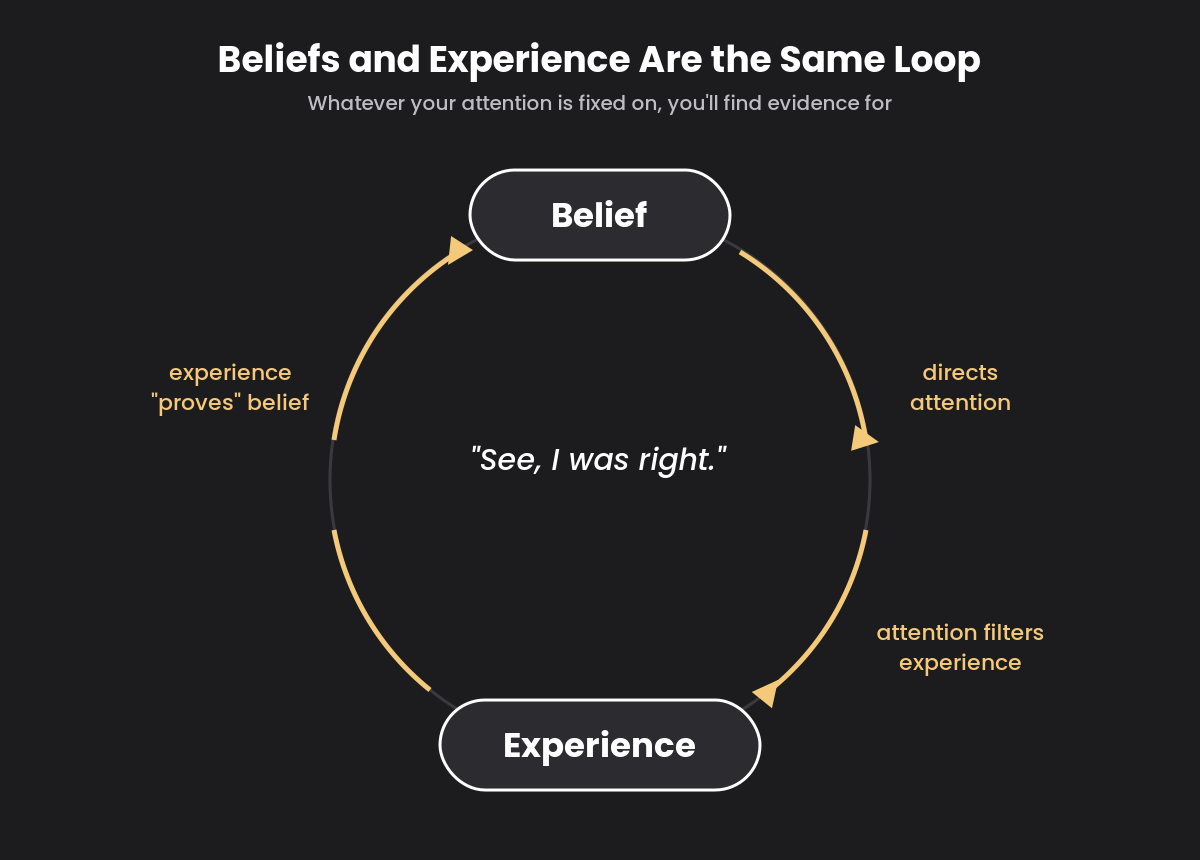
First, notice that beliefs and experience become synonymous. A generalized belief system gives you an experience of the world, and of yourself, that reinforces that very belief.
Say you believe wealthy billionaires are evil. You'll live in a world where that's all you see. Your attention filters for the behaviors that reinforce it. And it quietly deletes the rest: their philanthropy, their moments of benevolence, the love they show their children, their relatives, their mother, other people. Then the headline comes along and you think, "Aha. See? I was right."
Your beliefs are never wrong. If that's your area of fixed attention, that's all you'll ever see evidence of.
Articulating a Belief
Sticky beliefs are so generalized they are invisible. But because beliefs and experience are synonymous, we can work backwards from experience to find the beliefs. To find a belief, we use a system of inquiry about your experience to find the belief behind it. And the experience is typically an emotional state. A feeling.
There are two kinds of questions.
The horizontal belief question: What might someone (not necessarily you, someone like you) believe in order to have that experience? Take sadness, or grief. What might someone believe to feel that way? They might believe "life is too hard." or "No matter how much I gain, it's always lost."
Horizontal questions spread out. They show you the many beliefs sitting side by side around a feeling.
The vertical belief question: What would someone HAVE to believe to have that experience?
Notice the shift from "might" to "have to." Say the sadness and grief aren't a passing mood but a chronic sense, always there in the background. What would someone have to believe for that? "Life is just one loss after another." Or, "I am nothing."
Vertical questions go down. They help you get deeper, to the core organizing belief that holds a whole set of other beliefs together.
The core organizing belief
Sometimes beliefs look unconnected. Or even opposite. Take someone who believes both of these at once:
"Anything I want to achieve in life is achievable."
"It's not safe for me to do what I want in life."
On the surface they seem to cancel out. But there's a bridge between them, a core organizing belief: "I am stuck."
If you believe both of those things at the same time, you will feel stuck. The core belief explains the whole situation.
Try this: one feeling, two questions
Pick one feeling that keeps showing up for you.
First, the horizontal question: What might someone like me believe in order to feel this? Let a few answers come. There's no wrong answer here.
Then, the vertical question: What would someone have to believe to feel this, again and again? Take the answer that has a little weight to it.
Where, when, and with whom?
Once you get to the core organizing belief, it's helpful to ask yourself: Okay, where, when, and with whom was that belief formed?
Likely it wasn't formed recently. Especially if it's a chronic unwanted experience or a repeated behavior.
For the purpose of this post, we won't go there just yet. In the next post, we'll explore how to reframe decisions that have outlived their use.