

Working With Beliefs, Part One: Your Experience of Reality Is Not Reality Itself
Two friends fly to the same city. Same country, same week, same humid air hitting them at the bottom of the airplane stairs.
The first one has done her homework. She's read the forums and the travel warnings. She knows not to drink the tap water, not to flag a cab off the street, and not to wear her watch. Her body is braced before the plane even lands. On the first afternoon, a man on a scooter grabs her bag outside a café. A local shopkeeper shrugs and says it hardly ever happens around here. She spends the rest of the trip in her hotel room, counting the days until her flight home. The voice on the inside says, "I knew it. The world isn't safe."
(There's a quieter version of her, too. She reads the same warnings and never books the flight at all.)
The second friend lands in the same city, at the same airport, a few days later. Within an hour, a woman at the bus stop is drawing her a map on the back of a receipt. By the end of the week she's been invited to a cousin's wedding, eaten at a family's kitchen table, and swapped numbers with people she'll still be messaging ten years from now. The voice on the inside says, "People are so good. Things always work out for me."
Two people. Same place. Same streets, same heat, same smells drifting out of the same food stalls. Roughly the same sensory information, as we talked about in the last post. Two entirely different trips.
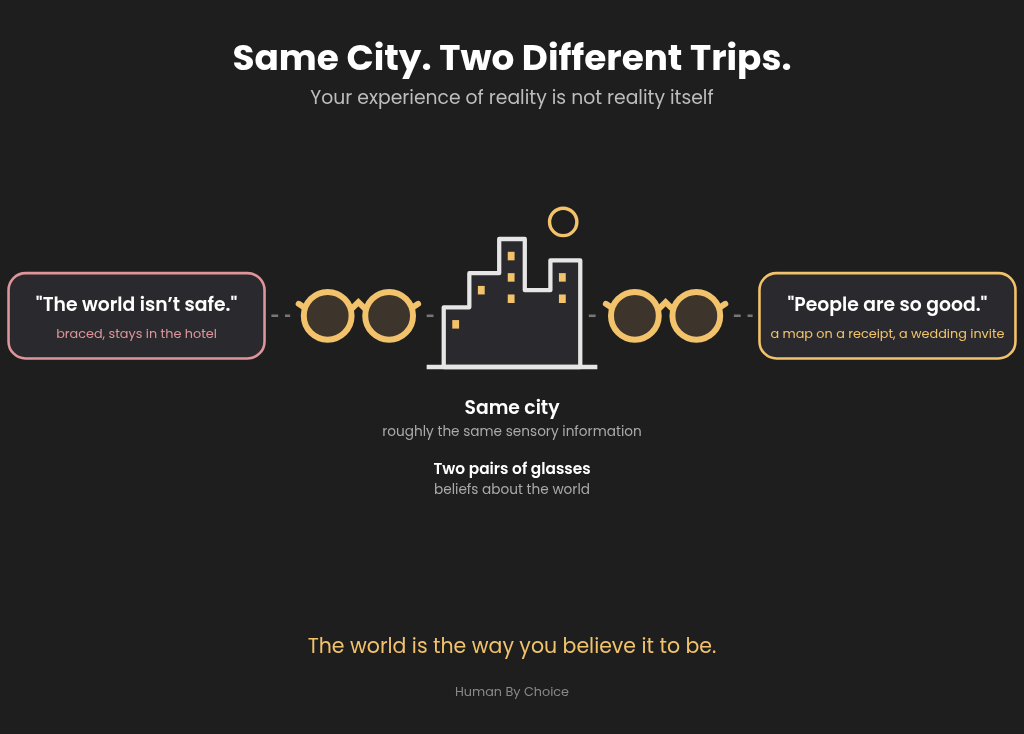
So what made the difference? It wasn't the time of day they flew. It wasn't the hotel, or the neighborhood, or which cab they got into. It was something underneath all of those choices. Beliefs.
The world is the way you believe it to be
Here's the idea I'd like to offer in this post, and I'm offering it as if it were true, not as universal truth: the world isn't simply the way it is. The world is the way you believe it to be.
That's a big claim, so let's slow down. I'm not saying gravity is optional or that the café thief was imaginary. What I'm saying is that the meaning of what happens, the feeling it leaves in you, what you do next and what you come to expect next time, all of it runs through what you believe. And what you believe shapes what you notice, what you walk toward, and what you avoid. Over time, that becomes your life.
Same story. Different traveler.
Try this: find a "truth" about the world
One note before we start. I'm not talking about the basic laws of time and space here: gravity, sunrise, the fact that a dropped glass breaks. Those are the shared rules of the world we live in, at least in this context. (In another context, even they may be more malleable than we think. That's a post for another day.) What I'm pointing at are the ideas we layer on top: what people are like, what the world will do to us, what's possible for someone like me.
Notice for yourself something you simply take for granted as the truth about the world. Not a preference. A fact. The kind of thing that makes you think, "Well, obviously."
Here are a few to get you started:
"Rich people are greedy. They'll extract every bit of value out of you and leave you with nothing."
"It's survival of the fittest. If you're not strong enough, smart enough, or well-resourced enough, you'll get left behind and eaten alive."
"The world is overpopulated, the climate is collapsing, and we're running out of everything. We're doomed."
"You can't trust anyone with your heart."
"Every day I get older, I lose a little more energy, a little more vitality, and a few more options for a good life."
Whatever yours is, write it down. One sentence. The one that feels most true.
Now try on a small experiment. Read your sentence again, and this time ask: What if this were just an idea for experiencing reality, and not reality itself?
Hold it the way you'd hold a pair of glasses in your hand, rather than wearing them. Notice how your experience of the statement changes. Maybe it gets lighter. Maybe there's a little more room around it. Then ask yourself one more question: What else is possible now?
Notice I didn't say your idea is wrong. Or invalid. Some ideas are wonderfully functional. If you believe the world is basically safe and things tend to work out for you, no matter how tough or uncertain they get, that's an excellent idea for reality in almost every context. Keep it. Polish it.
But consider the person who believes that every day she ages means something gets taken away. She turns down the dance class because "that's for younger people." She stops planning trips more than a year out. She hears "you look great for your age" and only hears the last three words. Each choice seems reasonable in the moment. Together they build exactly the shrinking life she was afraid of. Not because of her age. Because of the idea.
The point isn't to trade "bad" beliefs for "good" ones. The point is to have the experience that you have choice about them. That they aren't absolute.
Beliefs are generalizations about the world. In some contexts, a generalization makes a lot of sense and is genuinely helpful. In most others, it makes no sense at all. Say you grew up in a household where the people meant to care for you toyed with your heart. Inside that house, "I can't trust anyone with my heart" was wise. Closing your heart kept you safe. Beyond that house, the same rule makes it very hard to build the relationships you actually want, ones built on openness and trust. The belief didn't change. The context did.
What if your statement really is true?
Maybe you did the exercise and found it easy. Illuminating, even. Obvious. Maybe you've done something like it before.
Or maybe something else happened. Maybe you read your sentence and thought, No. This one is actually true. There's no way it isn't. Maybe the exercise annoyed you. Maybe it made you angry, and some part of you wanted to defend that statement for dear life.
I'm not going to try to convince you otherwise. I'll just say this: whatever that statement is, it's clearly something precious. If it weren't, you wouldn't be holding onto it so tightly.
In the last post we talked about how beliefs are often protecting something you love. In Transformational NLP, we say every belief is sourced from a strong positive intention. If it didn't have great value for you, you wouldn't be having it, no matter how confusing it might look from the outside. The traveler who stays in her hotel room isn't being silly. Some part of her is keeping her safe the best way it knows how.
So if you had a strong reaction, I'd invite you to try on one more question, and just sit with it:
Who might you be if this idea for reality were no longer true?
No need to answer quickly. Let it be a question for a while.
Going deeper: the beliefs behind your patterns of experience
Here's what all of this keeps pointing back to. Sensory experience is not the truth of who you are. And the external world, the sensory world, is not the home of your power or your creational authority. That comes from somewhere else: the context from which all of reality gets constructed for us to experience. Beliefs are one of the closest places we can see that construction happening.
So let's look at it directly, starting with the good stuff (beliefs that lead to experiences you want and enjoy).
Think of three or four experiences that reliably show up in your life and that you love. Here are some areas to look through:
Relationships and love. Partners, friends, family.
Work and career. Your colleagues, your clients, the work itself.
Money. How it comes in, how it goes out, how it feels.
Health and your body. Energy, healing, how you move.
Home and where you live. The places you land, the neighbors you get.
Travel and adventure. What tends to happen when you go somewhere new.
Play. Sports, hobbies, creative work.
Maybe strangers are always kind to you when you travel. Maybe you land in teams where people genuinely have your back. Maybe money has a funny way of showing up right when you need it.
For each one, notice the experience itself. What's the emotion? What's the feeling that reliably shows up there?
Then ask: What might someone believe in order to have that experience?
Not necessarily you. Just someone. Someone having an experience just like yours. What might they believe about people, about the world, about themselves?
You might find something like, "People want to help me." Or, "I belong wherever I go." Or, "There's always enough." This is how you start putting words to beliefs.
The beliefs behind what you don't want
Now the other side. Not harder or worse, just the experiences that don't feel good.
Identify three to five experiences that keep repeating in your life that you don't want. Use the same areas: relationships, work, money, health, home, travel, play.
Maybe it's the boss who always ends up taking credit. The roommate situation that turns sour every single time. The bank balance that drops to almost nothing right before the month ends, no matter how much you earned. The friendships where you're always the one who calls.
Again, notice the experience. The emotion. The feeling that reliably shows up.
And again, ask: What might someone believe in order to have that experience?
Not you, necessarily. Someone. Someone like you, having an experience like this. What might they believe?
You might hear something like, "If I don't do it myself, no one will." "Good things don't last." "People like me don't get to keep money." "I have to earn love."
Give it time
I'd encourage you not to rush this one. Our core beliefs operate beneath a lot of our conscious awareness. I call them invisible beliefs. They're so presupposed in our lives that there's no point thinking about them. They just run in the background, instinctively, as natural as breathing in and breathing out, or scratching an itchy nose, or swatting a fly off your face.
That's also why I keep asking what someone might believe instead of what you believe. It's a small doorway. It's much easier to see a belief when it belongs to someone else. You get to look at it from the outside, the way you'd notice someone else's glasses before you'd notice your own.
There's a line from Seth, the entity channeled by Jane Roberts, that I return to often:
"If you want to know what you think of yourself, then ask yourself what you think of others, and you will find your answer."
(Seth, channeled by Jane Roberts, Session 340, in The Seth Material)
So, if it helps, look at the people around you. Notice what you assume about them. You might find yourself there too.
Coming up in Part Two
That's it for Part One. In Part Two, we'll move from finding your beliefs to working with them, respectfully and with heart, so they can begin to shift in a direction that serves your life.
For now, try the exercises. Write down what you find. Notice what someone might believe in order to have the life you're living, both the parts that feel good and the parts that don't.