

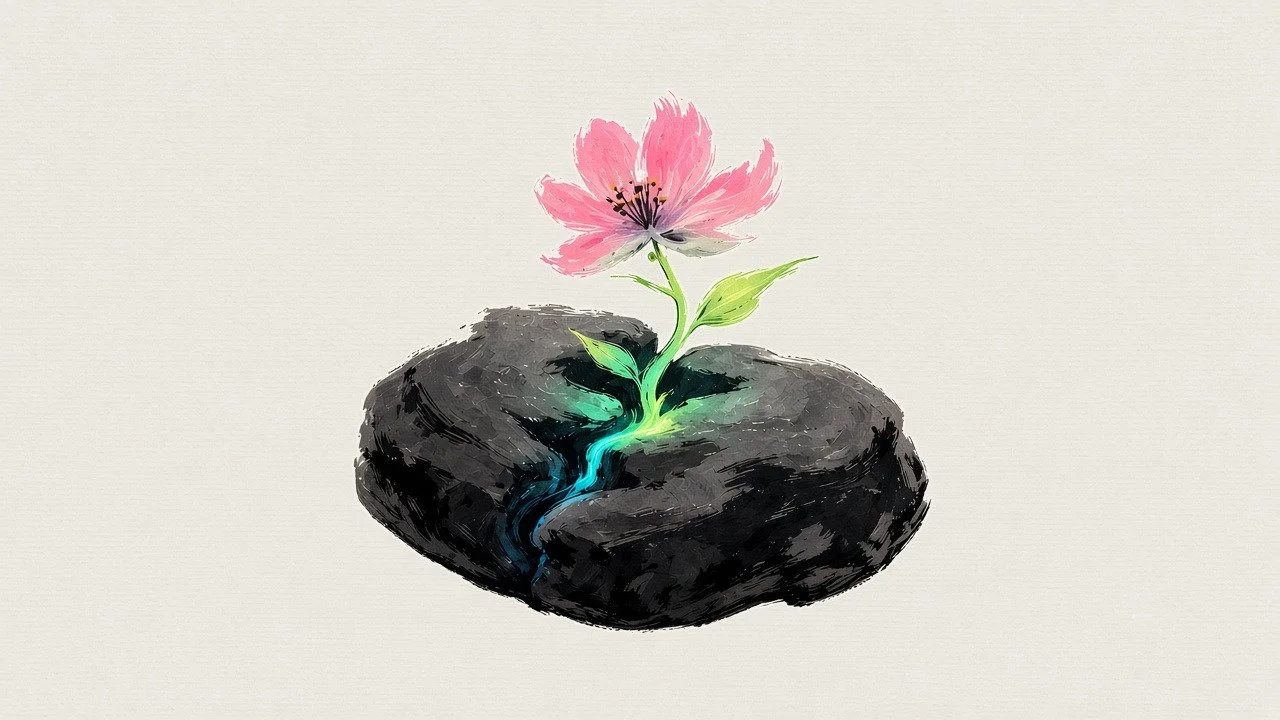
How much goodness can you bear?
Human beings censor good things that life is putting right in front of them, often mistaking them for bad things so much so that they are distrustful of life's goodwill. Often, it comes from beliefs about worthiness, deservingness, goodness, and badness.
This is Part 3 of the series. In Part 1, we looked at what validity is and how forgetting it feeds our addiction to gods and authorities. In Part 2, we looked at misappropriated love and the belonging paradox. Here, we look at what happens to the ease and joy of living a creative and enriching life.
The Worth and Deserving Trap: The belief that you have to be worthy of, or deserve, a good experience before you can have it. The need to be worthy or deserving of anything presupposes that your validity, and your right to good experiences, is in question.
The Worth and Deserving Trap
Think about what it means to need to be worthy of something. If I have to be worthy of ease, or of a good life, then I am already assuming my right to it is in question unless I meet certain criteria. Deserving works the same way. In Transformational NLP, we refer to "worth" and "deserving" to have implicit linguistic comparatives. They refer to comparisons against certain criteria (uniquely assigned person to person) in order to measure. It is a set of beliefs, and most of us run it without noticing.
Validity points to the inviolable integrity of your being, regardless of what you do or do not do. Unlike comparatives, validity has no measure. With validity amnesia, we forget that. Good things stop being something we get to have through implicit rights of being. Instead, they become something we have to qualify for through some specific set of efforts.
So, what happens when life sends something good, and sends it easily? The instinct is to distrust it, to disbelieve it, to almost be confronted with guilt or shame for something to have come our way so effortlessly. Often, human beings feel unworthy and undeserving of great things because we have not diminished or sacrificed enough of our well-being. This is a family of beliefs, and you probably know a few of its members. "Easy come, easy go." "Easy things aren't worth striving for." The list of resonant attitudes and beliefs goes on.
Anecdote About The Body and These Beliefs
The best analogy, in my experience, is developing strength and flexibility. The human instinct is to do numerous things with almost the exact same philosophical approach.
For strength, push harder. Lift more, lift harder. And this can well be done with good technique. Hinging at the waist versus arching the back, for example. The motion isn't the issue. The issue is the necessity to lift more and lift harder. For flexibility, people use momentum and extend the stretch beyond comforting positions, almost as if to fight the body into submission. The body will obey the command and fight too. The war with self continues.
I used to do 1000 kicks a day in Taekwondo. The reps had benefits. But I was so sore, torn, and lacked recovery time. I used momentum to develop flexibility too. Then I asked a different question: "How can I enjoy achieving this outcome easefully?"
That question led me to Feldenkrais. By slowing movements down and seeking more ease, the psyche changes to a state of ease, and it starts to show where concentrated fascia or tension is being held unnecessarily. Then it releases it. This is a similar principle to Tai Chi. It doesn't mean a lack of strength. It means slowing things down and seeking ease in movement. Not fighting yourself.
As one learns, you can achieve a lot with fewer reps. You can progressively load, easefully. You can get stronger without feeling sore and suffering after every session. Tai Chi is a good example of that. Flexibility has more enjoyable and easeful ways too: breathing and relaxing the nervous system, shaking out stored emotion and tension in the psoas using TRE1, or activating the muscles with isometric or active stretching, in small movements, to unlock bigger movements.
My flexibility, endurance, and efficient use of strength increased. Getting up on my surfboard felt 50% lighter, and I had not changed my body mass in any way. I managed to distribute force more naturally through my body. I'm 40 now. I surfed a 2-hour wave pool session (about 25 to 30 waves), then trained in a Taekwondo session that night. It felt great, though, I must admit I was extremely hungry later.
So, strength and flexibility aren't only about technique or form. They are more a state of the psyche. And it is more empowering to realize that time-space manifestations are a manifestation of the state of your psyche (beliefs, attitudes, assumptions, expectations) too. The form follows the psyche, not the other way around.
What if the body tends toward natural strength and mobility? And it is our attitudes, assumptions, and beliefs that limit that natural expression? It is the same with life.
What if life is already sending you the life support you want and need? In the form of the natural environment, business opportunities, and secure human support? If you could have what you are wanting without suffering or sacrifice, would you take it?
I'm not saying that suffering or sacrifice don't have their validity, though. But in Transformational NLP, we want to offer that suffering and sacrifice are better contributors if they teach you to stop suffering and stop sacrificing.
I'm not talking about not having to work, not having to learn, or not having to experience challenges. I'm talking about having a good outcome without feeling like you had to suffer and sacrifice. Would you take it? Would you feel good and great about your implicit right to that experience? Would you consider yourself, and your outcome, eternally valid?
Mistaking the Means for the Outcome
Human beings often do not distinguish the outcome from the means they believe they need to use to achieve it. True outcomes typically are states (feelings) that come with material representations. I wrote about this in Clarity Before Tactics. It walks through Transformational NLP's Outcome Frame questions one at a time.
Here is an example: Someone is working hard to attain more money through their business or career. You ask them the Transformational NLP Outcome Frame questions. "What will having that do for you?" And then, "What will having that do for you?" They might say, "I feel loved and fulfilled."
So, the question is: if you can feel loved and fulfilled now, regardless of whether that material outcome comes to light, would that be such a bad thing? Not to say you shouldn't want the material outcome. However, it shows that sometimes one's means of achieving love is to achieve status and financial resources first, thinking that will make them worthy of it. The problem is the presupposition that their worth is in question.
Now, this is understandable, as the experiences we learned to survive become the basis for continued survival (I wrote about this in How Things Get Stuck). In this example, it could be because the individual grew up with materially poor, struggling parents, and felt that if they could solve the financial issue, quality time and love and attention could be more abundant in their family. This is a loving child hoping to resolve the blocks to lasting connection. What that child doesn't know is that, implicit in their validity, they can have had all the feelings of love and fulfillment regardless of what they achieved or did not achieve. Unconditional love does not necessitate that one resolves the other's life challenges.
I also see highly successful business people talk about how lonely achieving the top outcomes can be. Only to find that the achievement was their way to avoid and fill that void, and that getting to the top did not fill it.
Picture someone who has finally arrived at the thing they worked toward for years. The title is theirs. The room goes quiet when they speak. The people who used to hold the door for someone else now hold it for them. They get home late. The house is quiet. They stand in the kitchen with the lights off, still dressed as the person who made it, and they wait for the feeling they were promised. They check for it the way you check a pocket for keys. Relief, maybe. Being held. Being enough. What arrives is a quiet that has no one in it. So they do the thing that has always worked. They set a bigger goal for next year, because the other option is to stay in the kitchen with the quiet and feel what all that climbing was keeping at a distance.
Life Is Not A Loan with Interest Payments
As a result of validity amnesia, human beings often feel they owe some entity something. God, their parents, their caretakers. Their life becomes some debt to be repaid. That is not to say you don't have to care, or want to give back to these entities. That exchange is natural. But you don't owe life or anyone anything. Your life came through your parents, held by the natural environment of time and space, and it is freely given from an inexhaustible source.
I know that one can make some people bristle. Maybe your parents did sacrifice everything for you. It is proper for parents to give and for children to take. A loving, functioning parent would not look at a baby and hope to withhold as much life and goodness from them. Furthermore, this does not mean you should not offer care and provide resources to aging parents. Far from it.
The difficult distortion is whether the parents give a lot to the child freely, or whether they do so with preconditions that the child will owe them in the future. As if they were debt collectors. This happens often, and it is a difficult environment for a child to work through. We cover this in more detail as part of Borderline Patterning in Transformational NLP.
For now, when you feel guilty that your parents sacrificed everything for you, it is natural to want to alleviate that guilt by giving back or by not being a burden. But "not being a burden" is a belief. You may have been difficult to raise, as is the nature of parenting, but that doesn't necessarily make you (who you are) a burden. Again, it is in the validity you experience about yourself.
Furthermore, guilt can take a few forms. Natural guilt means you will instinctively want to give back and care for those who gave to you in life. That is proper. Toxic guilt is the one that makes you feel like you owe your life to someone because of their good deeds to you. That is improper. Life does not hold its constituents hostage. It does not tally how much oxygen you have consumed only to deliver a bill when you take your final breath. The power of the Self does not hold itself hostage to its inexhaustible expressions. Though it can create a condition where it seems that way, through validity amnesia.
Easing Up for a Change
The goodness of life is eternally present in your being. Without this understanding, human achievement is stuck in the loop of:
"How can I suffer as much as I can so that I don't have to suffer?"
Now, you might say, is this post suggesting we become more lazy? Only if you want to. But let's talk about laziness. Lazy is full of presuppositions. It means you can do something but don't, and that you should do something but won't. These "shoulds" (modal operators of necessity) and expectations presuppose a judgment of character based on what a person does or does not do, and whether that fits within the expectations.
Easeful is a state that can include challenge, but not at the expense of well-being. When a flower blooms, it does push through with aggressive energy. But it is not slashing its stems and corroding its petals to do so. Similarly in your life, focusing on ease takes some effort and can come with natural aggression (the power of life). The main difference is the state of beliefs and attitudes you possess about yourself.
1 TRE stands for Tension and Trauma Releasing Exercises, a set of exercises that let the body shake out stored tension. Meta Lackland teaches it.