

Lasting Personal Change: Working Harder Is Not The Solution
Picture a friend who has spent years looking for a partner in New York. Dinner after dinner. App after app. Every guy seems to be in a rush, slow to respond, and fast to move on. Eventually, worn out, she packs two suitcases and moves to Lisbon. Slower pace, new language, new light through the kitchen window, a fresh start in every sense.
Within a few months she meets someone. He's warm and attentive, he remembers how she takes her coffee, and for the first time in a long while she lets herself breathe out, "Dating pool here is so refreshing. Finally, a change." Then, somewhere around week six, the texts slow down. He's "slammed at work." Plans get moved. Dinners turn into takeout on the couch with his laptop open. And she finds herself sitting in a beautiful apartment in a beautiful city, feeling the same thing she felt in New York: lonely, a little anxious, and emotionally unattended. The little familiar voice on the inside says, "Nobody loves me."
Same story. Different cast. Different set.
Maybe you know a version of this. It might not be romance for you. It might be the job where you work twice as hard and still get passed over. Or the savings account you keep building up, only to watch it drain back down. Or the fear you’ve “overcome” three times, which keeps showing up anyway, like a houseguest who has never once been invited.
If that’s you, here’s something I offer gently from my work as a Transformational NLP practitioner: nothing is wrong with you. And trying harder may not be the answer.
I’m not knocking hard work. Hard work on things you love, on things that matter to you, is one of the great pleasures of being alive. What I’m pointing at is narrower than that. It’s the repeating patterns of experiences, behaviors and outcomes that keep coming back no matter how much effort you throw at them to change.
Where most of us pour our effort
There's a useful map for this from Robert Dilts and Gregory Bateson, called the logical levels of change. Think of it as a tree.
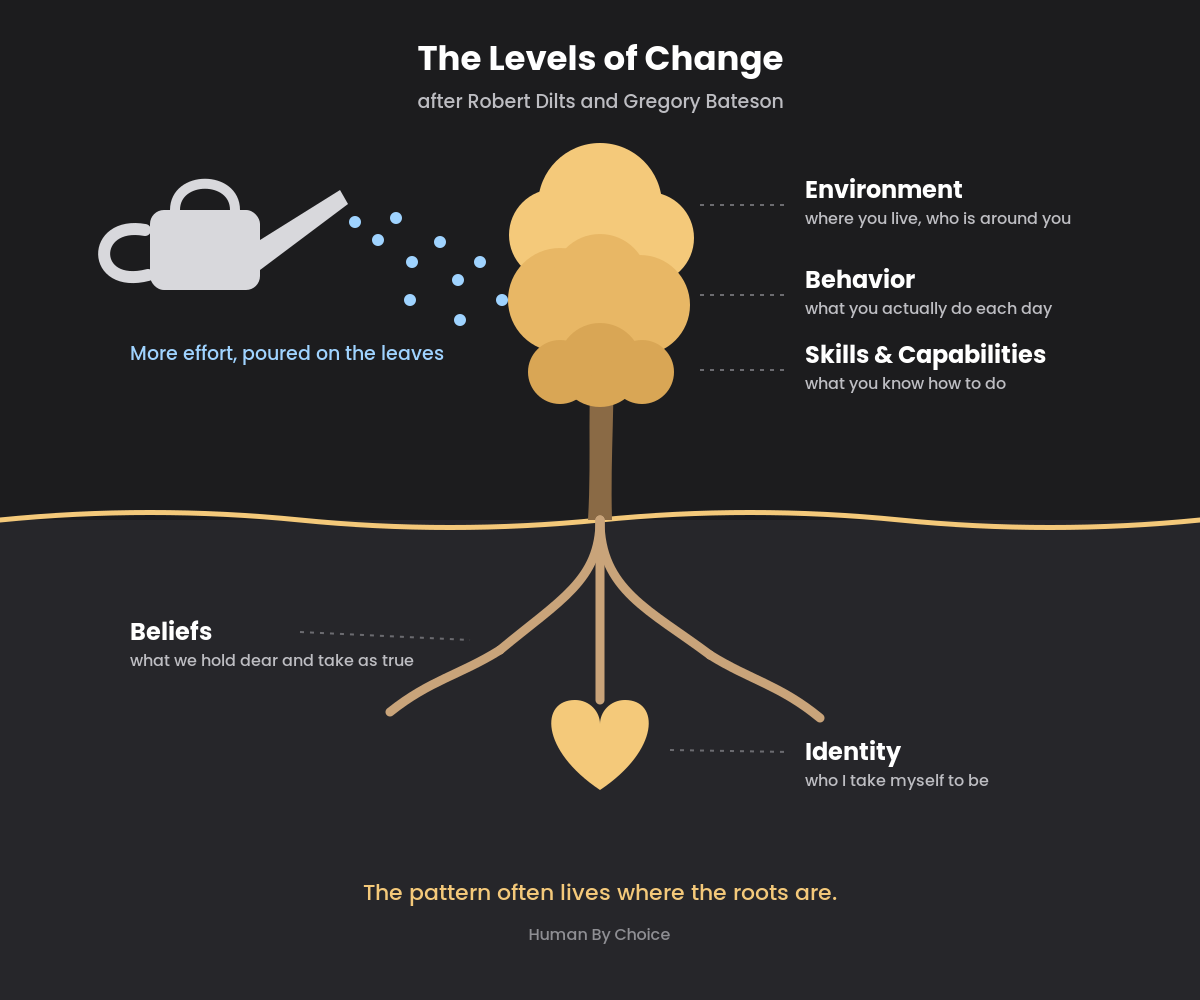
Above the ground are the leaves. Three of them, really:
Environment. Where you live, who surrounds you, what's on your calendar. This is the friend who moved to Lisbon. Different city, same person on the other side of the table, just wearing a different jacket.
Behavior. What you do. You set the alarm for 5 a.m., you stop eating after seven, you buy the good running shoes. For thirty days, maybe sixty, it's glorious. Then comes a Tuesday when it rains, you hit snooze once (it happens), and by Friday you're back to the old rhythm, with a small private story about willpower tucked in your pocket.
Skills and capabilities. What you know how to do. You want to earn more, so you invest in the master's degree. Then the certificate. Then the weekend intensive that cost as much as a used car. You're sharper than ever, and the promotion still goes to someone else, or you get it and somehow feel no different on Monday morning.
None of these levels is wrong to work on. Moving cities can be wonderful. Habits matter. Skills open doors. The trouble is when they're the only places we look. It's a bit like watering the leaves of a tree and wondering why it still looks sick. Pour more water. Water it earlier. Buy a better watering can. The leaves may perk up for a day or two, and then... well.
Where the pattern originates
Underneath the leaves are the roots. Two of them.
Beliefs. And underneath those, Identity: your sense of who you are.
These aren't places we usually think to look, mostly because we don't experience them as beliefs. We experience them as simply how things are.
Here's something I find lovely about the word. "Belief" traces back to Old English, to an old root that meant to hold dear. A belief isn't a stray thought. It's an idea about reality that we hold dear, a thing we take as true, because at some point it helped us explain the world.
And explaining the world is no small matter. One of the things children cannot stand (and, honestly, adults can't either) is not knowing how the world works. So we do what any good scientist does. We watch what happens, and we draw conclusions, fast, with the evidence we've got.
Say a boy is sitting in his family's modest kitchen when a man gets out of a gleaming car, with a driver, in a sharp suit. He walks in and delivers terrible financial news. Papers get signed. His mother cries. The boy doesn't have the language for debt or banking or how the economy works. But he is an excellent meaning-maker. Somewhere inside him, a conclusion forms: men wearing suits are bad people. They take things from people like us.
Now fast forward thirty years. That boy is a grown man who wants to build real wealth. He works hard. He's talented. And every time he gets close, something quietly goes sideways: a deal he talks himself out of, a raise he never asks for, a savings plan that mysteriously gets "borrowed" from. He isn't lazy. He isn't broken. He's loyal. Part of him cannot become the man who made his mother cry. He doesn't want to be a bad person.
Or take the girl who watched her father go quiet and distant every time her mother got upset. She may conclude that closeness is dangerous, or that people who love me leave. Years later she's drawn, again and again, to partners who are warm at the beginning and unavailable by month three. It feels like bad luck. It looks like a pattern. And it's actually a very faithful kind of loyalty. Because if closeness is dangerous, why wouldn’t you seek someone who is distant!?
None of this means the old beliefs were foolish. They were smart. They were what a small, brave person came up with to make sense of a big world. It's just that now we're carrying a rule written for a ten-year-old into rooms where a ten-year-old doesn't live. Human beings are famous for holding new futures hostage to past familiars.
How the filter works
Here's the part I think surprises people the most. Your beliefs don't just sit there like furniture. They act as a filter for everything that reaches you.
The human brain is an association, meaning-making machine. We make meaning about everything, all day long, usually at the speed of thought. Here's the sequence, and it's worth slowing down on it.
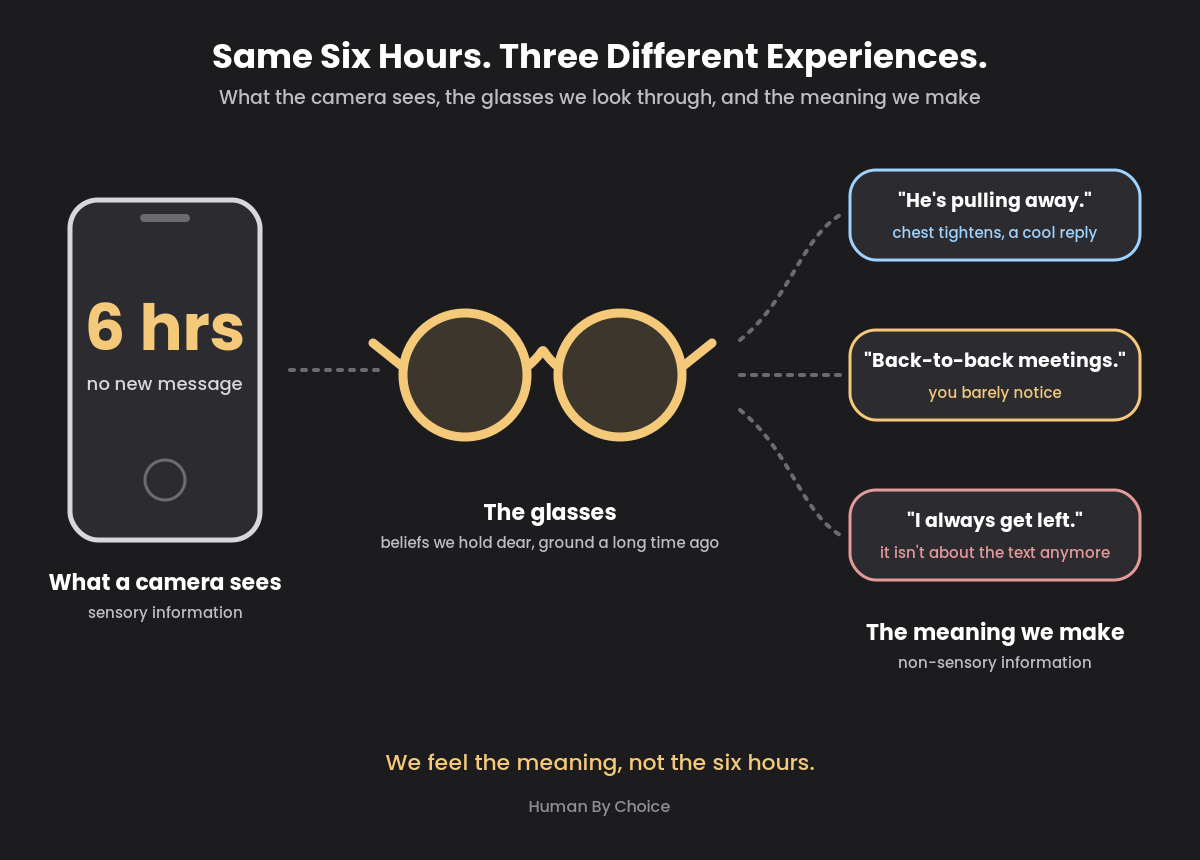
First, the world gives you sensory information: the things you can see, hear, feel, smell and taste. A person walks past you without saying hello. That's what a camera would catch. Nothing more.
Then your brain does something clever and fast: it assigns meaning. "She doesn't care." "He's losing interest." "I'm not important here." That meaning is non-sensory information. You can't see it or hear it or touch it. You made it.
And then (this is the important bit) the meaning you made is what you actually feel and respond to.
Try it with a small example. Your partner doesn't reply to your text for six hours. That's the sensory part: a phone, a screen, no new message. Now notice what happens when you pair it with different meanings:
"He's pulling away." (Your chest tightens. You draft a cool, short reply.)
"He's in back-to-back meetings and his phone is in his bag." (You barely notice.)
"I always get left." (Now it isn't about the text anymore.)
Same six hours. Three completely different experiences. And the person who tends to land on the third one isn't being dramatic. They're looking through a pair of glasses that were ground a long time ago.
Our brains also make this possible by compressing a very large world into a manageable size. They do it in three ways:
Deleting. We don't notice, or don't take in, parts of what's there. (The three kind things he did this week quietly go missing.)
Distorting. We reshape what's there into a different story. (A tired sigh becomes "he's fed up with me.")
Generalizing. We turn one experience into a rule. Red lights mean stop, which is a very handy rule. "Anyone in charge will bully me" is a rule that was handy once, in a hallway, a long time ago, and is considerably less useful in a meeting today.
I've written about this for founders and leaders over at Polaris Alpha, in a piece called Personal Bias: How to Decode and Work With Yours. The principle is exactly the same at home as it is at work. If you notice a strong reaction to something, you can ask yourself four quiet questions:
What did I actually see, hear, smell? (Just the camera version.)
What meaning am I making about it?
How could I prove or disprove that meaning?
What new information or awareness is available to me now?
You don't have to answer them perfectly. Just asking them loosens the glasses a little, so you can see that you're wearing them.
So where does this leave the world?
Here's a frame I work from. I'm offering it as if it were true, not asserting it as universal truth. There are certain things that are simply immutable: gravity, the laws of physics, the fact that Tuesdays keep happening. But the world around you, the one you actually experience, is quite malleable, depending on how you filter and respond to what comes in. And a great deal of that filtering runs through your sense of self and the beliefs you picked up early on and have carried, and matured, ever since.
Which means that if we only work on the leaves, we can be turning the wheel for decades. Chasing an outcome that keeps eluding us, not because we lack grit, but because we've been searching a different room from the one where the pattern lives.
Beliefs are often protecting something you love
Now, here's the part I care about most.
When most people discover a limiting belief, the first instinct is to fight it. Overcome it. Stamp it out. But overcoming your fears and limitations is like trying to win an arm-wrestle with yourself. You can't really win. It's a zero-sum game with self. There's always another round.
So we get curious instead. Because very often the belief is protecting something you love.
The man who won't let himself get wealthy might be protecting his mother, and his belonging to the family he came from. The woman drawn to unavailable partners might be protecting her father's place in her heart, or keeping an old promise never to need too much. If you look at where you hurt the most, you'll often find where you love the most.
This work is gentle. We don't rip out the belief. We honor it, thank it, understand what it has been guarding, and then offer something new: a way of holding that same love that doesn't cost you your life. And the change that follows can take root in a person naturally, over time, without needing to remember to be any different.
The Work
My work is informed by Transformational NLP, the New Psychology of Carl Buchheit, and relational work. Over the next few posts, I'll share some of the most common limiting beliefs and statements of identity that quietly hold people back, and then a high-level model for meeting them respectfully and with heart.
For now, here's something small to try. Think of one pattern that keeps coming back in your life. You don't need to fix it or analyze it. Just place your attention on it, and notice what someone might believe in order to have an experience just like that. That belief is precious.